General Assembly 2025
The Energy Economists Association renews the executive Committee and its Bureau, including
president, Vice-President and Secretary-General
On Tuesday 9 December 2025, the Energy Economists Association held its General Assembly.
The Commission, represented by more than a quarter of its members, was able to deliberate validly, as provided for in the Statutes. The vote was taken in electronic form with a presentation at 12.30 p.m. in PSE.
Christophe Bonnery, President, read out the moral report and the financial report. Quitus was given to a majority of the votes cast by the General Assembly.
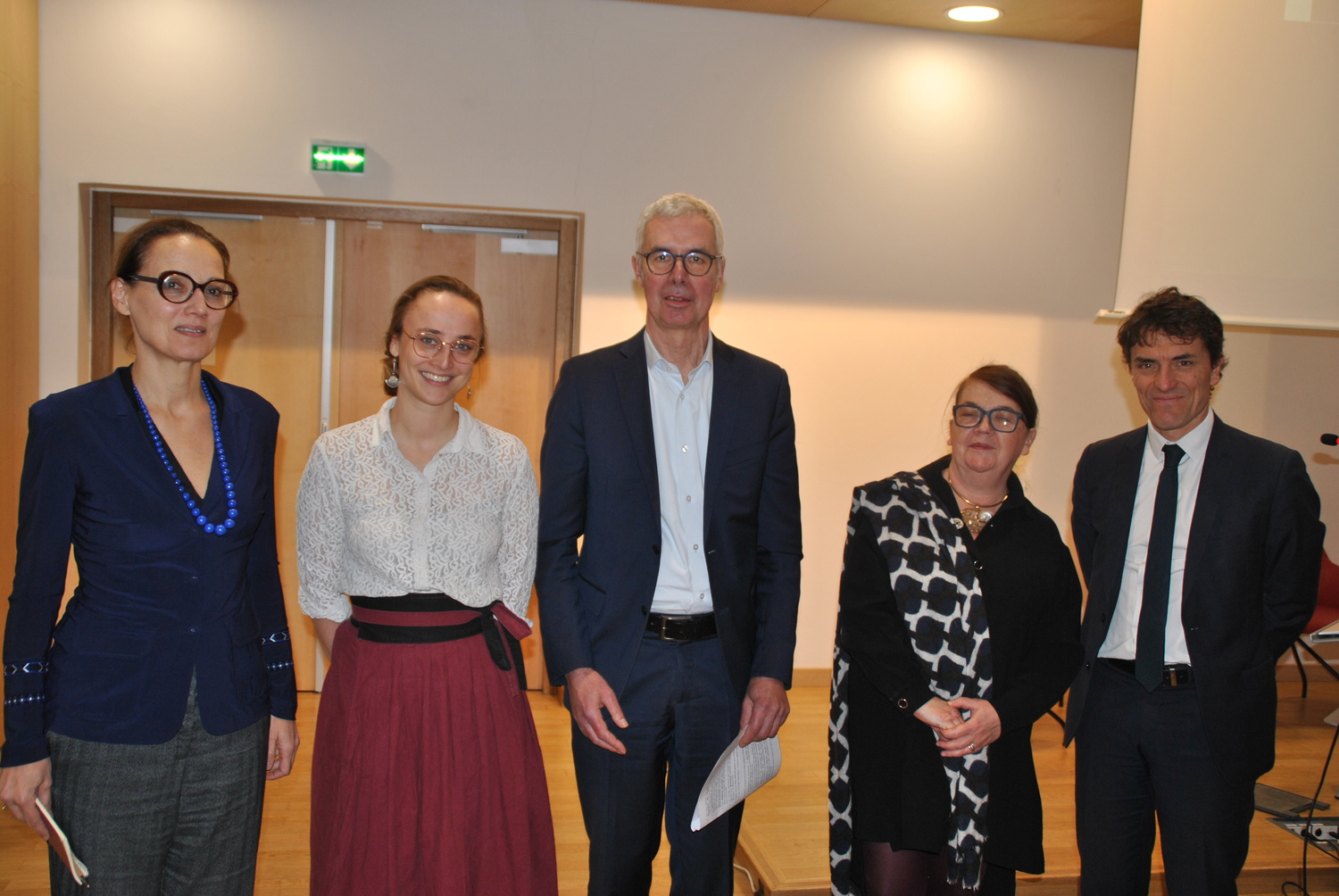
On the proposal of the Steering Committee, Chloe Le CoqVice-Chairperson, was elected as Chairperson to replace Christophe Bonnery, which was no longer a candidate for his estate after 5 three-year terms.
The vote also concerned the election or renewal of other members of the Committee whose term had expired.
On the proposal of the Steering Committee,
• Fabienne Salaün, Secretary General, is elected Vice President in place of Chloé Le Coq.
• Benoit Esnault, member of the Steering Committee, was elected Secretary General in place of Fabienne Salaün.
• the mandate of Nicolas Astier as a member of the Steering Committee shall be renewed,
• the mandate of Cedric Clastres as a member of the Steering Committee shall be renewed,
• the mandate of Fabien Roques as a member of the Steering Committee shall be renewed,
• election of Violaine Tarizzo was elected a member of the Steering Committee.
After 15 years of office (2010-2025), Christophe Bonnery was elected Honorary President EEA.
The other members of the Steering Committee are E.Jagu, D.Charlier, TO.Léautier, R.Loisel, PL.Lucille, O.Massol, B.Solier, ML. Vaiani, V.Rious.
The results were promulgated at the General Assembly in accordance with the EEA Statute. (ELECTIONS)
Christophe Bonnery, President of EEA, took stock of EEA developments during his tenure: "
- Thanks to an enhanced conference offer, the number of members increased by 4.5, from 64 in December 2020 to 291 in October 2025, excluding legal persons
- The number of legal persons increased from 7 to 11 over the period
- France has moved from 4th to 2nd place in the international ranking of associations of energy economists, just behind the USA,
- On this basis, I was identified in 2017 to become President of the IAEEE, bringing the words of French economists to the international scene
- The candidacy of Paris was chosen to organize the international conferences of the IAEEE in 2021 and 2025. Its success is measured as the greatest participation in the history of the IAEEE. Success largely due to the teams I chose (Y.Perez and C. Clastres) and measured by the financial balance sheet that will help EEA in its future.
- The topics discussed in our conferences are chosen in a logic of diversity and economic lighting of our members
- The EEA governance steering committee has reached a perfect diversity of genders and generations. The Bureau has passed.
These results were achieved through the active contributions of the members of the Steering Committee, each in its own style. A thousand times thank you
Future challenges remain for EEA:
- maintain and strengthen the plurality of the topics addressed and the spirit of contradictory and academic debate prevailing in our conferences
- pursue the ambition of spreading applied economic science to energy rather than abstaining from discussions with peers, third parties or an international network
- strengthen knowledge exchanges with all actors contributing to energy debates such as journalists or some NGOs, parliamentarians.
- capitalize on the debates in our events by using editors to write the proceedings of the conferences
- strengthen the vast pool of synergies with IAEEE. »
The meeting rose at 1.30 p.m.
More information on EEA: www.faee.fr (accession conditions, conferences, missions)
Contact: administration@faee.fr
About EEA:
The EEA, established in 1986, represents the International Association for Energy Economics (IAEE) in France.
It brings together energy economists, whether they belong to energy companies, government and public institutions, education and research, or consulting companies.
It deals with the economic science applied to energy, its role in economic and political life and in particular public energy policy decisions. She addresses these topics from an academic and non-corporate perspective.
The EEA is an exchange forum that organizes more than 20 conferences a year on issues linking economic science and energy technologies, also integrating societal, environmental and political dimensions.
It includes an active student section.
It operates in the form of an association law of 1901 under the direction of its President and a Steering Committee representative of the vocation of transversality of the Association.